
NCA&T to lead ag tech corridor project with $1M NSF grant
Funded by a $1 million grant from the National Science Foundation’s Regional Innovation Engines, North Carolina Agricultural and Technical State University (NCA&T) will lead a team of university, N.C. Cooperative Extension, business and research partners in developing a plan to share information and technology faster and more broadly across the state by building an “ag tech corridor” from central North Carolina to the east.
Agriculture, the state’s top economic driver, is in every corner of the state, but most of the research and technological innovation that could be available to the $103 billion industry comes from companies and universities in the comparatively small urban areas of the Triad and Triangle.
Gregory Goins, Ph.D., associate dean for research NCA&T’s College of Agriculture and Environmental Sciences, says that imbalance can leave farmers without exposure to research-based techniques and new technologies, particularly those that can help lower the barriers to market entry for limited-resource farmers so that they can be successful in the face of climate change and develop entrepreneurially.
“New farmers, underserved farmers and those with small-scale acreage need information to develop farm management practices to implement methods that protect the environment, produce the highest quality food and provide a reliable family income,” Goins said, in an NCA&T announcement on Friday, March 15. “Our team seeks to develop a plan to bring information from industry to farmer, particularly in underserved areas, to help them mitigate climate impacts, lower the barriers to market entry that they face, and boost the agricultural sector’s economic output.”
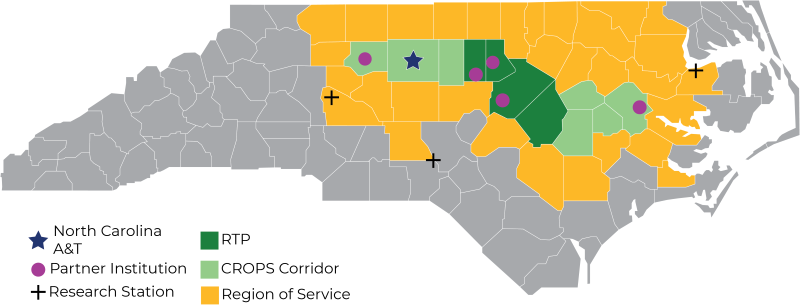
The project, called Climate-Responsive Opportunities in Plant Science (CROPS), brings together researchers from Duke University, East Carolina University, North Carolina State University, University of North Carolina at Chapel Hill, and Wake Forest University; specialists and county agents from N.C. Cooperative Extension; industry partner North Carolina Biotechnology Center; and nonprofit research institute Research Triangle International with the N.C. Community College System. Together, they will create a plan to develop a 42-county Agricultural Tech Innovation Corridor to enable improvements in agriculture to reach underserved areas of the state faster.
Through a mix of educational programming, workforce development activities and startup grant funding, the 10 institutions will provide educational programs that deliver up-to-date information on such topics as farming technologies, agricultural business management and natural resource conservation, Goins said. The project also proposes ways to help small producers identify new crops and livestock enterprises that have the potential to increase farm income and assists them in developing community-based local food systems.
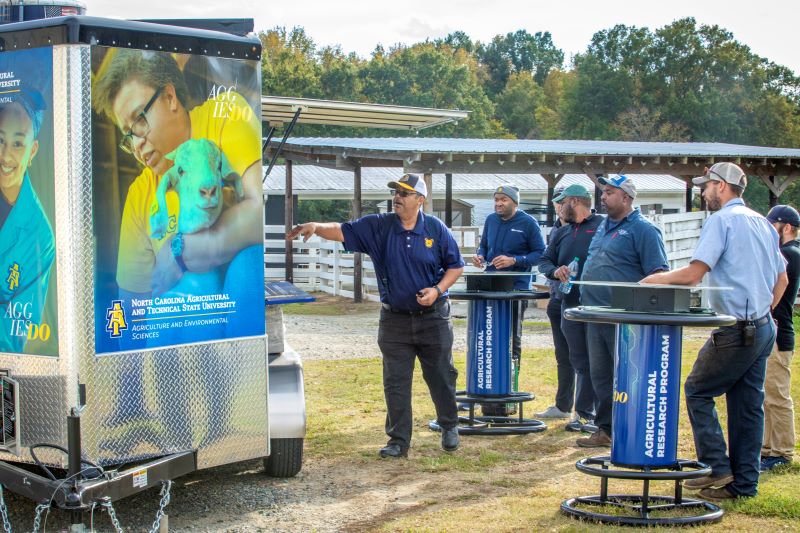
Environmental Sciences, makes a presentation in the field using a solar-powered
charging trailer. The trailer one way NCA&T brings research-backed methods
to farmers across the state.
The program also has a strong workforce development component to foster small-scale farmland economic performance as well to increase diversity in farming, Goins said. The program will stress climate-smart techniques and ways to create climate resilience and provide information about technologies to help agricultural operations thrive. Programs are free to participants.
NCA&T is the first and only historically Black university to lead one of NSF’s “Engines,” which are grant-funded projects designed to promote science and technology as regional economic drivers. With a potential investment of $1.6 billion in the next decade, Engines is one of the largest investments in regionally-based research and development in U.S. history, according to the foundation. Since January, the foundation has awarded 10 projects in 18 states. North Carolina is the only state with three Engines awards.
“Thanks to our history of serving small, limited-resource and minority farmers, A&T is well positioned to lead this effort,” Goins said. “Trust will be key in closing the gap between them and access to traditional agricultural support programs, help them take advantage of strong, inclusive, and resilient marketing opportunities, resolve heirs property issues, provide newer technology solutions where traditional methods are being used and increase their representation in farming.”
“We will make farmers the crucial role-players in this project by going to them and seeing what they need,” he said. “Then, we’ll address those needs with farmer-focused, participatory programs.”
The program will begin this spring with listening sessions across the state, said Biswanath Dari, Ph.D., assistant professor and natural resource specialist at N.C. A&T Cooperative Extension.
“We have all the resources in higher education, and agriculture, right here in North Carolina, to make a difference to small growers,” said Mark Blevins, Ed.D., assistant administrator of NCA&T Cooperative Extension. “CROPS not only brings farmers, funders and researchers together, it brings universities and business agencies together to serve them in ways that haven’t been done before. Together, we can do more than any of us can do on our own.”
Legal Disclaimer:
EIN Presswire provides this news content "as is" without warranty of any kind. We do not accept any responsibility or liability for the accuracy, content, images, videos, licenses, completeness, legality, or reliability of the information contained in this article. If you have any complaints or copyright issues related to this article, kindly contact the author above.
