
Single-use bags – reviewing recent developments and perspectives regarding sustainability
Plastic and sustainability – an overview
Single-use bags are found in different shapes and various areas. Their impact on the environment also depends on here and how they are used.
FüGEN, TYROL, AUSTRIA, March 5, 2024 /EINPresswire.com/ -- Single-use plastic grocery bags, as they are found in grocery stores and supermarkets, have multiple negative effects on the environment – from their production down to their often improper disposal. But although they are, reasonably, being banned in everyday life, this does not apply to all single-use packaging.The pharmaceutical industry relies on single-use bags as primary packaging for liquid medicine as well. Perhaps surprisingly, this is widely considered to be more sustainable than multi-use alternatives.
The following lines will give an overview of current developments and perspectives in different sectors dealing with single-use plastics. Moreover, it will become clear in which specific circumstances single-use technologies and solutions are used, and if the environmental impact they have can be justified.
What makes single-use plastics problematic?
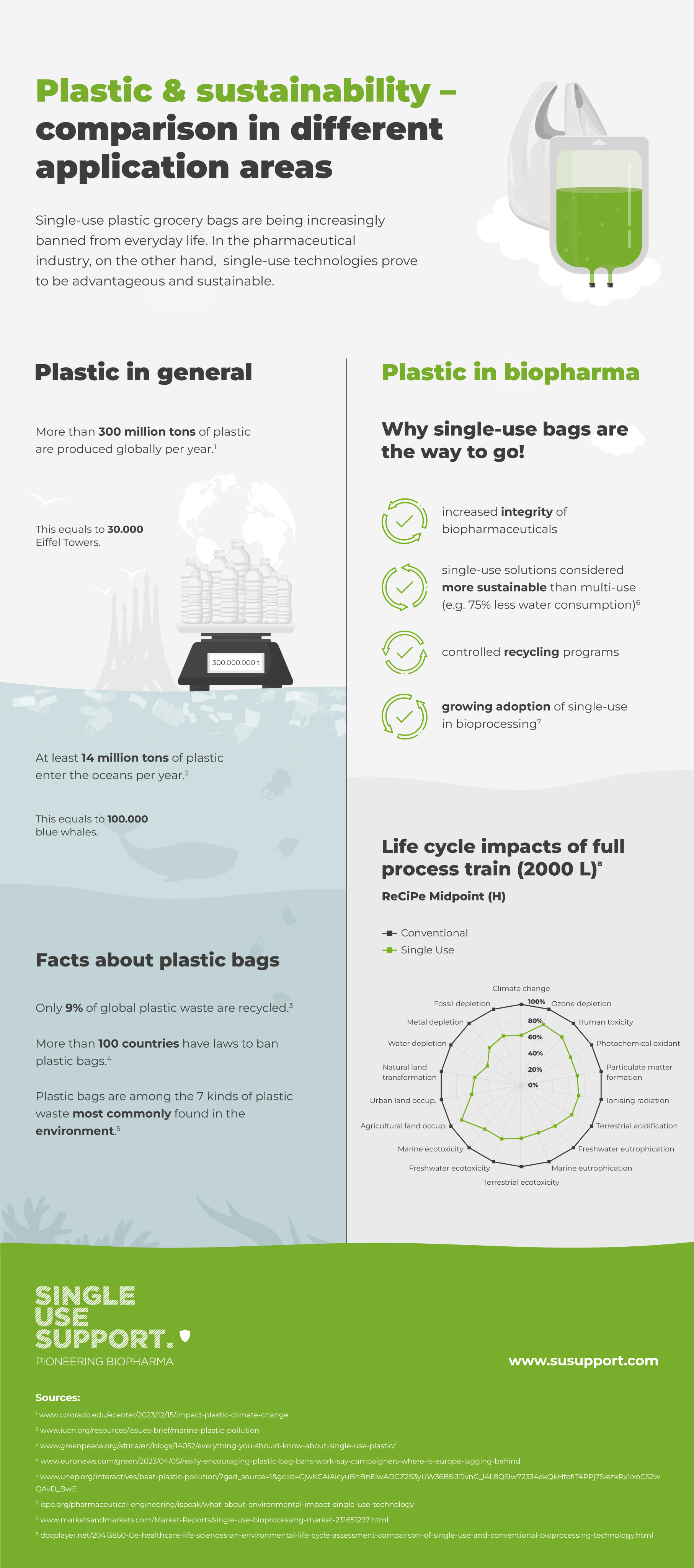
Laws are being enforced to reduce the amount of plastic carrier bags: More than 100 countries have enacted laws that ban single-use plastic bags partially or entirely – among them 8 states in the U.S. by 2021, lacking a uniform regulation. [1, 2, 3]
Even though entities like the UN Environment Program stress the importance of reducing the usage of single-use plastics, half of the plastic currently produced is designed to be used only once. This is problematic for several reasons. [4, 5]
Oil-based production
Plastic is usually based on non-sustainable fossil raw materials. There are estimations that the greenhouse gases emitted to obtain and bring fossil fuels to plastic factories amount between 1.5 and 12.5 million metric tons, while their refinement adds another 184 to 213 million metric tons each year. [6]
Inadequate disposal of waste
Single-use plastics require adequate ways to dispose of these materials. Although there are possibilities to recycle plastic waste, only 9% actually take that path. The remaining 91% of global plastic waste is dumped or burned. As for plastic grocery bags, they belong to the group of the seven kinds of plastic waste to be most commonly found in the environment. [7, 8]
Pollution
Plastic is non-degradable, harming both flora and fauna. However, plastic does alter its shape over time – but not necessarily for the better: Microplastics that result from dissolution of plastic waste pollutes the environment. As they enter global water reservoirs such as the oceans, microplastics ultimately enter the food chain and, that way, the human body. [7]
Positive environmental effects of single-use technologies?
Despite the substantial downsides associated with single-use plastics, these materials do have their benefits. While convenience, lightweight, and ease of production may be obvious benefits, single-use technologies are often also claimed to have less negative impacts on their environment compared to multi-use pendants, as pollution is not the only aspect to be considered. [9]
This is mainly because of the reduced need for laborious cleaning and refurbishment procedures: The higher the standards that are to be adhered to in a certain area in terms of hygiene, the more difficult it is to recondition multi-use products once they have been utilized.
One exemplary field, where hygienic standards are especially elevated, is the pharmaceutical industry: Particularly in bioprocessing, solutions based on single-use technologies are heavily relied on. Furthermore, thorough life-cycle planning can ensure that single-use products are disposed of accordingly.
Single-use technologies in the pharmaceutical industry
Biopharmaceuticals must be protected from contamination by all means: If there are impurities in the product, the batch of product must be thrown away. Product loss can lead to substantial costs for pharmaceutical companies. However, the damage is even greater when contamination remains undetected and poses an unacceptable risk to patients.
Single-use plastic is therefore widely adopted in the pharmaceutical industry, and in fact, this field is still growing: When speaking of revenue, the global market of single-use bioprocessing was estimated to value USD 8.2 billion back in 2021, and expected to grow to USD 20.8 billion in 2026. [10]
Manufacturers of single-use bags for biopharmaceuticals, bioreactors, tubings and other assemblies produce integral components for several pharmaceutical processes. However, when speaking of single-use bags in biopharma, these packagings are rather different from conventional plastic carrier bags.
They are crafted in high-end materials that have to comply with high industry standards. Additionally, recycling can be ensured under controlled conditions, as many manufacturers give precise instructions or take an active part in it.
Apart from various practical reasons to adopt single-use technologies – such as increased flexibility, safety, and reduced costs –, it may surprise that they are also widely considered more sustainable in biopharma compared to traditional multi-use solutions. [9]
Reduced resource consumption in favor of single-use plastic in biopharma
Durable stainless-steel systems require extensive cleaning and sterilization processes, whereas single-use components are disposed of right after usage (for instance tubings in pharmaceutical fluid paths). This has a significant influence on the overall resource consumption.
In terms of water consumption, the impact of disposable solutions is more than 75% lower than that of conventional systems. Additionally, by opting for single-use solutions instead of traditional approaches, the impact on ecosystem quality can be reduced by approximately one third. Equal numbers are achieved when considering the aspect of human health. [9]
Single-use plastics – reallocation instead of abolition
Weighing out the pros and cons of single-use plastics, it becomes clear that the general status quo could be better. However, trends can be individualized, stressing that things are improving – the European Union, for instance, is aiming to significantly reduce the amount of plastic responsible for maritime pollution. [11]
Instead, it is important to reallocate the use of single-use plastics to areas where they are actually beneficial, e.g. in biopharmaceutical manufacturing, where adequate recycling can be ensured. This calls for a sensible choice of when and where single-use products should be relied on in the future.
Sources
1 https://www.euronews.com/green/2023/04/05/really-encouraging-plastic-bag-bans-work-say-campaigners-where-is-europe-lagging-behind
2 https://www.ncsl.org/environment-and-natural-resources/state-plastic-bag-legislation
3 https://www.statista.com/chart/14120/the-countries-banning-plastic-bags/
4 https://www.unep.org/news-and-stories/story/how-reduce-impacts-single-use-plastic-products
5 https://www.unep.org/interactives/beat-plastic-pollution/
6 https://www.colorado.edu/ecenter/2023/12/15/impact-plastic-climate-change
7 https://www.greenpeace.org/africa/en/blogs/14052/everything-you-should-know-about-single-use-plastic/
8 https://www.unep.org/interactives/beat-plastic-pollution/?gad_source=1&gclid=CjwKCAiAlcyuBhBnEiwAOGZ2S3yUW36B5IJDvnG_l4L8QSlw72334ekQkHfoflT4PPj7SlezkRx1ixoCS2wQAvD_BwE
9 https://ispe.org/pharmaceutical-engineering/ispeak/what-about-environmental-impact-single-use-technology
10 https://www.marketsandmarkets.com/Market-Reports/single-use-bioprocessing-market-231651297.html
11 https://environment.ec.europa.eu/topics/plastics/single-use-plastics_en
Benjamin Graus
Klixpert.io
email us here
Legal Disclaimer:
EIN Presswire provides this news content "as is" without warranty of any kind. We do not accept any responsibility or liability for the accuracy, content, images, videos, licenses, completeness, legality, or reliability of the information contained in this article. If you have any complaints or copyright issues related to this article, kindly contact the author above.
