
Blended Cement: Enhancing Durability, Sustainability, and Workability in Construction | Allied Market Research
Blended Cement 2031
Blended Cement Market by Type (Portland Pozzolana Cement (PPC), Portland Slag Cement (PSC), Composite cement, Other)
PORTLAND, UNITED STATES, March 1, 2023 /EINPresswire.com/ -- Blended cement, also known as composite cement, is a mixture of Portland cement and supplementary cementitious materials (SCMs). The SCMs can be natural or industrial by-products, such as fly ash, slag, silica fume, limestone, and pozzolanic materials. Blended cement has been widely used in the construction industry due to its several benefits, including improved workability, durability, and sustainability. In this blog, we will explore the characteristics, advantages, and disadvantages of blended cement.
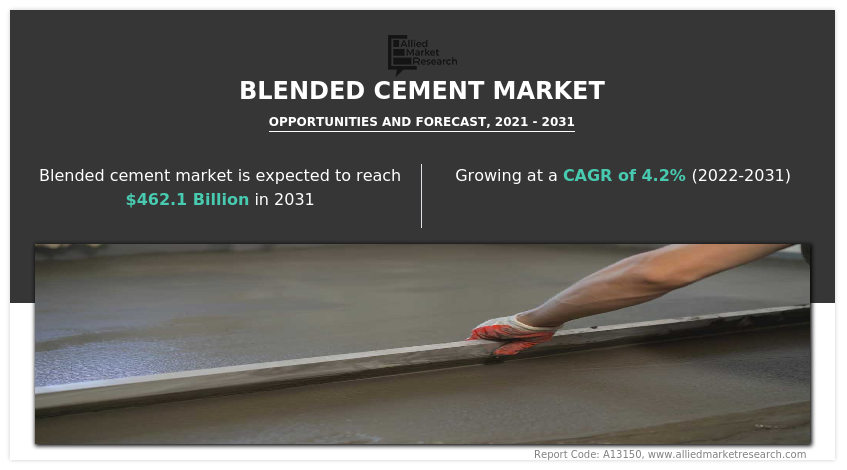
blended cement market size was valued at $301.2 billion in 2021, and is projected to reach $462.1 billion by 2031, growing at a CAGR of 4.2% from 2022 to 2031.
𝐃𝐨𝐰𝐧𝐥𝐨𝐚𝐝 𝐒𝐚𝐦𝐩𝐥𝐞 𝐑𝐞𝐩𝐨𝐫𝐭 : https://www.alliedmarketresearch.com/request-sample/13515
Competitive analysis and profiles of the major players in the blended cement market include : Ambuja Cements Ltd, Anhui Conch Cement Company Limited, Buzzi Unicem SpA, China National Building Material Company Limited, CRH plc, CEMEX S.A.B DE C.V., Dalmia Bharat Limited, Holcim, HeidelbergCement AG, UltraTech Cement Limited are provided in this report. Major players have adopted product launch and acquisition as key developmental strategies to improve the product portfolio of the blended cement market.
Characteristics of Blended Cement:
Blended cement has several unique characteristics that make it a popular choice in the construction industry. Some of these characteristics include:
Reduced heat of hydration: The presence of SCMs in blended cement reduces the heat of hydration, making it less susceptible to cracking.
Enhanced workability: Blended cement has improved workability, making it easier to mix and place. This allows for faster and more efficient construction.
Increased durability: The SCMs in blended cement increase its resistance to chemical attack, improving its durability.
Lower carbon footprint: The use of SCMs in blended cement reduces the amount of CO2 emissions during production, making it a more sustainable option.
𝐁𝐮𝐲 𝐓𝐡𝐢𝐬 𝐑𝐞𝐩𝐨𝐫𝐭 : https://www.alliedmarketresearch.com/checkout-final/0156cfde9634ff2dc7dffa552ca8826c
Advantages of Blended Cement:
Improved sustainability: Blended cement is a more sustainable option as it reduces the amount of CO2 emissions during production. This makes it an eco-friendly option for construction projects.
Increased durability: The use of SCMs in blended cement increases its durability, making it more resistant to chemical attack and reducing the likelihood of cracking.
Cost-effective: Blended cement is often less expensive than pure Portland cement, making it a cost-effective option for construction projects.
Improved workability: Blended cement has improved workability, making it easier to mix and place. This allows for faster and more efficient construction.
Better performance: Blended cement has better performance than pure Portland cement in terms of strength, setting time, and shrinkage.
Disadvantages of Blended Cement:
Longer setting time: Blended cement often has a longer setting time than pure Portland cement, which can slow down construction projects.
Variability in properties: The properties of blended cement can vary depending on the type and amount of SCMs used. This can make it difficult to predict its performance.
Lower early strength: Blended cement may have lower early strength than pure Portland cement, which can be a concern in some applications.
Potential for alkali-silica reaction: The use of some SCMs in blended cement can lead to alkali-silica reaction (ASR), which can cause cracking and damage to concrete structures.
𝐏𝐮𝐫𝐜𝐡𝐚𝐬𝐞 𝐄𝐧𝐪𝐮𝐢𝐫𝐲 : https://www.alliedmarketresearch.com/request-sample/13515
Applications of Blended Cement:
Blended cement has several applications in the construction industry. It can be used in the construction of buildings, bridges, roads, and other infrastructure projects. Some of the applications of blended cement include:
High-performance concrete: Blended cement is often used in the production of high-performance concrete due to its improved workability, durability, and sustainability.
Mass concrete structures: The reduced heat of hydration in blended cement makes it a good option for mass concrete structures, such as dams and large retaining walls.
Marine structures: Blended cement is often used in marine structures, such as docks and seawalls, due to its increased resistance to chemical attack.
Sustainable construction: Blended cement is a sustainable option for construction projects as it reduces the amount of CO2 emissions during production.
David Correa
Allied Analytics LLP
+1 503-894-6022
email us here
Visit us on social media:
Facebook
Twitter
LinkedIn
Legal Disclaimer:
EIN Presswire provides this news content "as is" without warranty of any kind. We do not accept any responsibility or liability for the accuracy, content, images, videos, licenses, completeness, legality, or reliability of the information contained in this article. If you have any complaints or copyright issues related to this article, kindly contact the author above.
